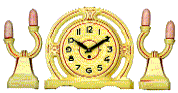
In the interwar period, when you stepped in a common
home in Belgium or in the North of France, you would inevitably notice a
superb ceramic clock proudly standing on the chimney mantel with its two
sidepieces.
It was indeed an unstoppable craze which gave birth to tens of millions of
creative clocks, with an extraordinary variety of shapes and decorations. It
owes its origin with the development of the mechanical industry.
Indeed up to the middle of the 19th century, a clock
was an expensive object: its clockwork was hand made. The possession of
time was thus reserved to the elite. Alarm-clocks started to be produced
industrially in Germany around 1850; but it was only at the beginning of the twentieth
century that some really cheap clockworks started to be manufactured in the Black Forest and France. Ceramic (faience) was then the inexpensive "plastic" material:
in ceramic producing areas, it was chosen to dress these clockworks. So
clocks became handsome and affordable to everybody.
Therefore in the Twenties a significant faience clock industry developed in Belgium and North of France. And because
owning the time was important in the developing industrial world, the
ceramic clock ended up in the focus point of the house, the chimney. It became
a mantelpiece ornament, the clock being surrounded by two sidepieces,
vases or cups. In the twenties and the thirties, it was not only a valuably
useful object, it was also the nice object of the house, proudly and
conspicuously decorating the chimney mantel.
To satisfy the unprejudiced taste of this new market,
ceramic producers were very creative. The clock shape sometimes
recall that of middle-class bronze or marble clocks; some bear animals or
peoples sculptures; others refer to the Art-Deco architecture or to Greek
temples.
Their decorations are also infinitely varied, often
very colored, sometimes extravagant. Some imitate marble or stone, others
refer to modern decorative styles, to Chinese or Dutch porcelains, to
traditional tableware or to avant-garde modernistic painting. Often the
decoration matches the shape and bear transfers or stencil drawings
especially created. The sidepieces topic, shape and decoration match those
of the clock, contributing to the esthetics of the mantelpiece.
Several ceramic factories specialized in these mantel clocks. Among the
most productive ones are four factories of the Borinage,
the coal-mining center of Belgium: the factories Thulin, Jemappes, and
especially the factories "Auguste Mouzin and Co" and " La
Majolique" in the small village of Wasmuël. In France,
the main ceramic clock factories were "Berlot & Mussier" in
Vierzon and Somain in Northern France. Some Czech
factories created clocks for export to Belgium and Northern France,
especially after 1930: the "G. Bihl AG" factory and three
others, yet to be identified. Also a few German factories produced some
pieces, mainly for export.
After the 2nd world war, the mantelpiece clock fashion declined. Rising wage increased the cost of faïence, and with the advent of the consumer society, other goods became
more attractive. Among those, wrist watches became affordable and became the normal timepiece
to wear. After the war, only minor ceramic clocks were
produced, intended for kitchens or bedrooms. Also some bright colorful
models without sidepiece were created especially for poorer countries where
the sun shines (Southern Italy, North Africa...).
This market loss as well as the fast rising labor costs gradually turned
the ceramic factories into bankruptcy. Today remains only a small
production, abroad, intended for Third World countries.
Most Belgian ceramic clocks were produced in the south-west coal-mining
region called the Borinage. The two factories which truly dominated the
ceramic clock market were in the same small village of Wasmuël (now
attached to the town of Quaregnon).
The first one, initially named "Auguste Mouzin et Cie" (AMC)
then "La faiencerie de Wasmuël", functioned from 1878 to 1951.
It produced mainly fine quality ceramic pieces. To diversify it's
income, it started around 1910 a massive production of mantel-clocks:
more than a hundred models with several decorations each, which were the
bottom-end of their production
(click here
to see the photos of some clocks).
On the other hand the second one, "La Majolique Wasmuël "
(1904-1960), mainly produced common ceramic objects: the mantelpiece
clocks were their top-end production. They made a hundred models with many
decorations, often into two or three sizes.
In addition to the two factories of Wasmuël, some other ceramic
factories also lead the Belgian market. Among those, the factory of Thulin (1863-1971) created about sixty
models, decorated with melting enamels dripping on one other. The factory Terra in Jemappes (1915-1966) was also very productive:
about fifty models, decorated with all kinds of techniques.
Several other factories of the Borinage had a small production:
The factory Antoine Dubois (or Bergen) in Mons (1920-1950)
produced a score of models with several decorations.
A factory in Tertre produced about fifteen models, often in
brown and white colors.
The famous factory of Nimy (1789-1951) created at least 7 models.
The family factory Wilfried Collart in Baudour (1936-1956)
produced some models, all hand-painted by the daughter of the founder.
The small factory Lebrun in Quaregnon (1936-1940) created about ten
models.
The great factory Boch Keramis in La Louvire (Center) only
produced a few models.
Finally, several other factories, yet to be identified, also produced
a few
clocks each.
Flemish factories (Turhout, Kortrijk, Brugge...) only produced a few models, generally decorated with a technique similar to that of Thulin.
Let's finally mention the Minerva clocks: imposing, they were probably
contracted by a Belgian importer of clockworks.
After the second war, the ceramic mantelpiece clock production
significantly decreased and their quality went down. Most factories
were forced into bankruptcy. However a new factory, Hubert Bequet, in Quaregnon (1942-1974), kept on producing successfully quite a
score of models.
More than Belgium, France knew to popularize the Art-Deco style . This
style strongly influenced the ceramic mantel-clock production.
The biggest French clock producer was by far the Berlot & Mussier
factory in Vierzon (not far from Limoges). In the Twenties and the Thirties it
produced nearly one hundred clock models, signed "ODYV",
strongly influenced by the Art-Deco style. After the second war, it produced
another 35 models or so, intended especially for the
North-African markets. Most of these clocks are of plain color and often
richly gilded or silvered. This factory is also known for its
production of animals sculptures in cracked ceramic.
Another specialized producer was the "Fabrique de Cramique et
Verrerie d'Art" of Somain (North): founded in 1925 by two defectors
of the nearby factory Dransart, Messrs Jacobs and Tranchant, it produced
more than twenty mantel-clock models, before being destroyed by the
Luftwaffe on May 18, 1940. Their style resembles the Belgian clocks; most
are hand-painted and some carry the signature "Tho" of
Mr. Tranchant.
Some larger factories also penetrated the clock market. For
instance, the Lorraine factory of Sarreguemine, founded in 1790,
produced about thirty models. Several factories of Northern France
produced half a score of them: Fives-Lille, Saint-Amand, Moulin des Loups, Onnaing
and Orchies. Many factories produced only a few models: Saint-Clment,
Vallauris, Longwy, Quimper, Desvres...
Lastly, let's mention a not yet identified factory (inventory
"S?1") which produced about twenty models that are difficult to
distinguish from those of Somain.
The Czech part of Czechoslovakia had many large ceramic factories of
excellent quality. From 1930, they signed trade agreement with France and
Belgium, allowing them to import their production at a competitive price.
They then created many mantelpiece models exclusively for export, which
invaded the Belgian and French markets. These clocks are recognizable to
their fine stencil decoration.
The only Czech faience factory we identified so far is the
"Earthenware and Porcelain Factory G. Bihl & CO AG" in
Ladowitz (Ledvice), Bohemia, which started around 1900 and closed in 1939
or 1940. It produced about sixty models,
among which a score of "scenes" - rectangular clocks topped by animals in the round.
The production of three other factories, yet to identify, show many
similarities with that of Bihl; therefore we believe them to be Czech.
These factories are:
The one inventoried "PPP", which produced at least about
fifty models in many stencil decorations;
The one inventoried "St", which produced about forty
models;
And the one inventoried "Names ", which produced a score of them.